
A quote from a Chinese factory usually names a trade term: EXW, FOB, CIF or another of the Incoterms® rules of the International Chamber of Commerce (ICC). The rule decides who arranges and pays for transport, who clears the goods for export and import, and where the risk of loss or damage passes from the seller to you; under CIF and CIP it also obliges the seller to insure the goods. It does not decide when you become the owner of the goods or how and when you pay. For most orders from China, the practical choices are FCA at a forwarder's warehouse or a container terminal, or FOB at a Chinese seaport. EXW leaves Chinese export clearance to you, and under CIF the factory chooses the carrier and the insurance while the sea voyage is at your risk. Here is how the main rules work under Incoterms® 2020 and what to agree with the factory.
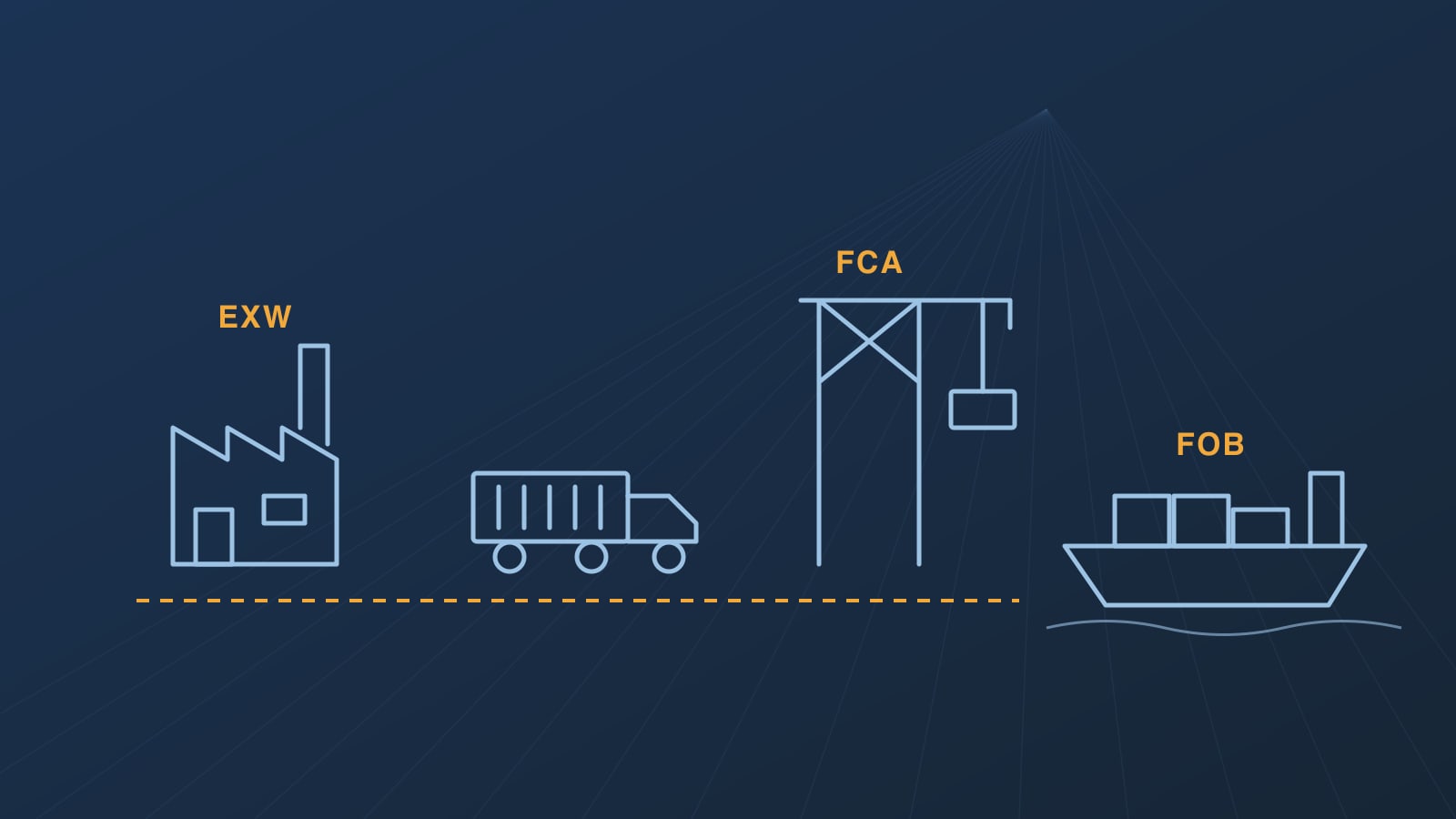
Eleven rules in two groups
The current edition is Incoterms® 2020; ICC has started work on the next one, Incoterms® 2030. Seven rules can be used for any mode of transport: EXW, FCA, CPT, CIP, DAP, DPU and DDP. Four are for sea and inland waterway transport only: FAS, FOB, CFR and CIF.
Always write the rule together with a precise place and the edition, for example "FCA Shenzhen, [address of the forwarder's warehouse], Incoterms® 2020" or "FOB Yantian, Incoterms® 2020". Under EXW, FCA, FOB and the D rules the named place is where the seller delivers the goods and the risk passes to you. Under the C rules (CPT, CIP, CFR and CIF) it is the destination to which the seller pays the carriage, while the risk passes earlier, at shipment. Ownership, payment terms and what happens if one side breaks the contract are not covered by the rules: put them in the sales contract.
EXW: Chinese export clearance becomes your job
Under EXW (Ex Works) the seller only places the goods at your disposal at its premises or another named place, not loaded on any vehicle and not cleared for export. From that moment the risk is yours. If the seller loads the goods anyway, the risk of damage during loading may also fall on you, so ICC advises agreeing in advance who bears it — or choosing FCA, under which, if delivery is at the seller's premises, the seller loads the goods and keeps the risk during loading.
Under EXW it is also up to you to carry out and pay for export clearance. In China an export declaration is filed by the Chinese consignor of the goods or by a customs broker it entrusts, and both must be on file with customs. Only a market entity registered in China — a company, partnership, sole proprietorship or branch of a foreign company — can be put on file (General Administration of Customs, Order No. 253, Articles 2 and 4; Order No. 277, Article 4). A foreign buyer with nothing registered in China cannot be that consignor, so in practice the factory or an export agent declares the goods anyway — which is exactly what FCA provides for.
FCA: export cleared, handed to your carrier
Under FCA (Free Carrier) the seller clears the goods for export and hands them over to the carrier or forwarder that you nominate, at a named place. At the seller's premises, the goods are delivered once they are loaded onto your carrier's vehicle. At any other place, such as your forwarder's warehouse or a container terminal, they are delivered when they arrive on the seller's vehicle, ready for unloading and at the disposal of your carrier or forwarder; the seller does not unload them.
The risk passes to you at that point, and from there you book and pay for the main transport. FCA works for sea, air, rail and road. If your bank's letter of credit requires an on-board bill of lading, the 2020 edition lets the parties agree that you instruct your carrier to issue one to the seller once the goods are loaded on the vessel; the seller then passes it to you. ICC warns that the carrier may refuse, since it issues such a bill only when the goods are actually on board, and that the different dates of delivery and of loading may cause difficulties under the letter of credit. Check with your carrier or forwarder first.
FOB: for loading on board, not for containers handed over at a terminal
Under FOB (Free On Board) the seller clears the goods for export and delivers them by placing them on board the vessel that you nominate at the named port of shipment. The risk passes when the goods are on board. The seller pays all costs until then; you pay the sea freight and everything after loading, and insure the goods if you want cover.
FOB is a rule for sea and inland waterway transport only. ICC notes that it does not fit goods handed to the carrier before they are on board, such as containers delivered to a terminal, and that in this case the parties should consider FCA. If a factory still quotes FOB for a container shipment, confirm in writing which port charges and documents before loading are included in the price.
CFR and CIF: the seller pays the freight, the voyage is at your risk
Under CFR (Cost and Freight) and CIF (Cost, Insurance and Freight) the seller contracts and pays for carriage to the named port of destination, but the risk passes to you when the goods are on board the vessel at the port of shipment. If the goods are lost or damaged at sea after loading, that is your risk: you claim against the carrier or the insurer. The seller still answers under the sales contract for defects that existed at loading. If the goods first travel on a feeder vessel or river barge, the risk passes by default when they are delivered to the first carrier, so name the port of shipment and the point of delivery in the contract.
Under CIF the seller must also insure the goods, but by default only on the limited Institute Cargo Clauses (C), for at least 110% of the contract price, and the policy must let you claim directly from the insurer. Clauses (C) cover only the listed risks. Under CIP, the any-mode counterpart, the 2020 edition by default requires the broader Clauses (A). In both rules the parties may agree on another level of cover; under CFR the seller need not insure at all.
The seller also chooses the carrier and signs the contract of carriage. Unloading costs at the port of destination are yours unless they were for the seller's account under that contract; if the seller paid them under it, it cannot charge them to you separately unless you agreed otherwise. The carrier's local agent may bill you for destination charges, so ask for them in writing before you agree to CIF. For containers delivered to a terminal, ICC points to CPT and CIP rather than CFR and CIF.
DAP and DDP: delivered in your country
Under DAP (Delivered at Place) the seller delivers the goods on the arriving means of transport at the named place in your country, ready for unloading. You clear them for import and pay the duties and taxes.
Under DDP (Delivered Duty Paid) the seller also clears the goods for import and pays the import duties and taxes. ICC notes that if the seller cannot obtain import clearance it should consider DAP or DPU instead, and that import taxes paid by the seller may not be recoverable from the buyer. A DDP offer is realistic only if the seller can actually clear the goods for import in your country.
Duty is charged on the value with freight and insurance
In the six countries covered by our import guides — Chile, Peru, Colombia, Mexico, Saudi Arabia and the United Arab Emirates — customs duty is calculated on a customs value that includes freight and insurance up to the point where the goods enter the country (in Chile and Peru this is called the CIF value). Import VAT is calculated on that value plus the duty and other import taxes. Buying FOB instead of CIF therefore does not lower your duty: customs add the freight and insurance anyway. What changes is who chooses the carrier and the insurance, and what you pay for them. In Peru, if the goods are not insured, customs adds an insurance cost at a standard percentage of the FOB value. In Colombia the insurance document, or a document supporting the usual insurance rates, must accompany the import declaration.
What we recommend
Sea, by container or groupage (LCL): FCA at your forwarder's warehouse or the container terminal in Shenzhen or Guangzhou, which is what ICC recommends for goods handed over before loading; FOB only if the factory insists. You or your forwarder book the freight, and you insure the goods, for example on Institute Cargo Clauses (A).
Air and express: FCA at the factory with your forwarder's or courier's account, or DAP if the factory's courier rate is better than yours.
EXW: avoid it unless an export agent will declare the goods in China and you have agreed who loads them.
CIF: it suits goods loaded directly on board; for containers ICC points to CIP. In either case, check the destination charges and the insurance cover first.
What to agree in the contract
1. The rule, the precise named place and "Incoterms® 2020"; under CFR and CIF, also the port of shipment.
2. Who books the transport and who insures, on which clauses and for what amount.
3. The packing and marking, and who loads at the named place.
4. The documents: commercial invoice, packing list, bill of lading or air waybill, certificate of origin where your country has a free trade agreement with China (Chile and Peru, among the countries of our guides), and the insurance policy if the seller insures.
5. Under FCA with a letter of credit, whether you will instruct your carrier to issue an on-board bill of lading to the seller.
6. The latest date of delivery at the named place.
How we help
We ask factories for quotes on the same rule and place so that offers can be compared, arrange FCA delivery at a forwarder's warehouse or terminal in Guangzhou or Shenzhen, and check the export documents before the goods leave. Send us the product, the quantity and the destination, and we will reply with options within two business days.
Sources
International Chamber of Commerce: Incoterms® 2020 — introduction, rules for any mode of transport and rules for sea and inland waterway transport, with explanatory notes (ICC Digital Library, library.iccwbo.org); the ICC pages on Incoterms® 2020 and the ICC Global Policy Commissions workplan for 2026 (revision towards Incoterms® 2030); US International Trade Administration, "Know Your Incoterms"; General Administration of Customs of China, Order No. 253 on the filing of customs declaration entities (2021), Articles 2 and 4, and Order No. 277 on customs declarations (2025), Article 4; State Council of China, Regulations on the Registration of Market Entities, Article 2; customs and tax rules of Chile (Compendium of Customs Rules, chapter II; Decree-Law 825, Article 16), Peru (Andean Community Decision 571, Article 6; SUNAT procedure DESPA-PE.01.10a), Colombia (Decree 1165 of 2019, Articles 327 and 330), Mexico (Customs Law, Article 65; VAT Law, Article 27), Saudi Arabia (ZATCA guideline on imports and exports under VAT, May 2026; GCC Common Customs Law) and the United Arab Emirates (Federal Decree-Law No. 8 of 2017 on VAT, Article 35).
The Incoterms® rules are protected by copyright owned by ICC. Further information on the Incoterms® rules may be obtained from the ICC website, iccwbo.org. Incoterms® and the Incoterms® 2020 logo are trademarks of ICC. Use of these trademarks does not imply association with, approval of or sponsorship by ICC.