
A media facade turns the outside of a building into a screen or a light show. Three common technologies are LED mesh screens, linear and pixel lights, and grille screens. They differ in resolution, weight, power and the kind of content they can show. Before ordering one for Chile, check two sets of rules. The light-pollution standard DS 1/2022 requires advertising and decorative lighting to be switched off between midnight and 7:00, and since 19 October 2026 new installations anywhere in the country must meet all of its limits (in special protection areas — Áreas de Protección Especial — which include most communes of the Antofagasta, Atacama and Coquimbo regions, since 19 October 2024). The advertising law 21.473 allows only still images on electronic advertising screens that can be seen from public roads and spaces. Here is how to choose, what the rules say and what to ask the factory.
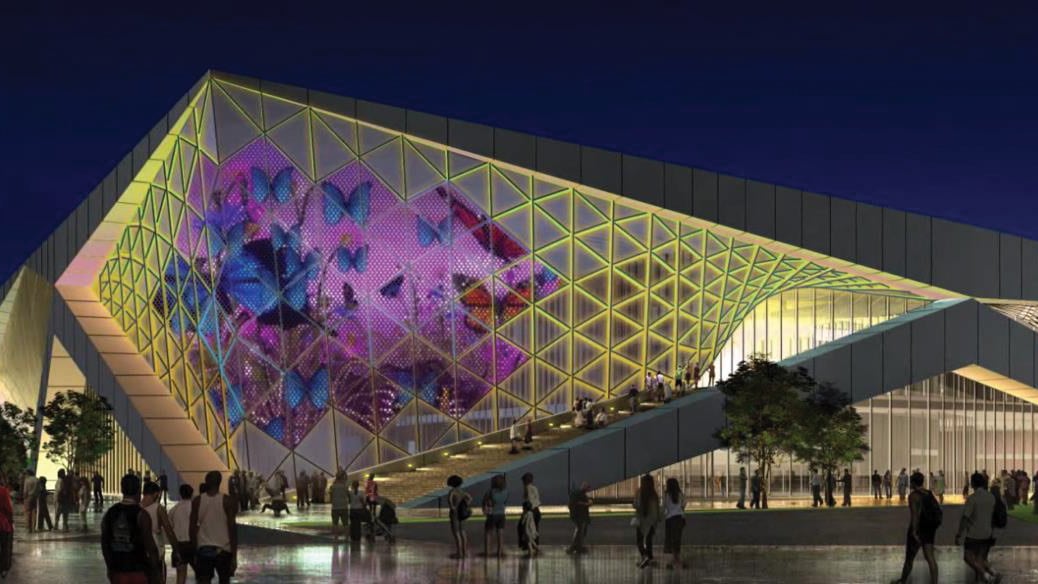
Three technologies
LED mesh screens. LED pixels are fixed on cables or thin bars that form a net, which hangs from steel wire ropes in front of the facade. In the catalogue we used, the distance between pixels — the pixel pitch — is 50 to 150 mm. Because the surface is mostly open, part of the daylight and the view from inside passes through. In a mesh table one manufacturer sent us, the open area rises from 30% at a 31.25 mm pitch to 87% at 150 mm, and the weight falls from 10 to 1.2 kg per m².
Linear and pixel lights. Light bars and individual light points follow the lines of the building: edges, windows, floors. They are usually controlled over DMX512. Their resolution is too low for detailed video, so they draw outlines, colours and effects, and they suit buildings where the architecture itself should stay visible.
Grille screens. Metal bars with LEDs on a finer pitch, about 15 to 31 mm in the datasheet we used, often different horizontally and vertically (for example 15.625 × 31.25 mm). They give a sharper image for viewers closer to the building; at 7.5 kg per m² without power boxes they weigh more than a mesh of 50 mm pitch or coarser, though less than a 31.25 mm mesh.
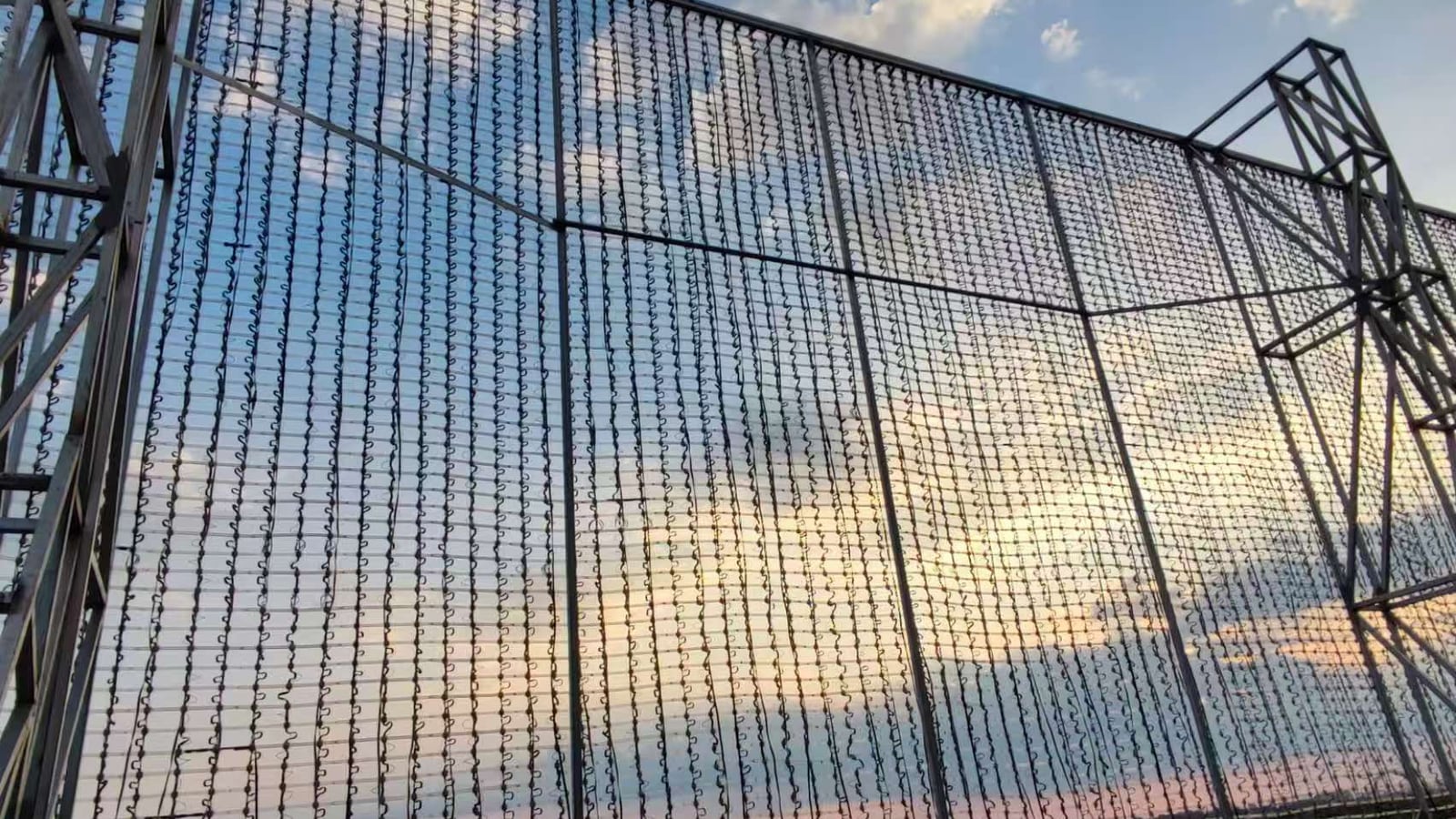
Pixel pitch and viewing distance
The number of pixels per square metre follows from the pitch: (1000 ÷ pitch in mm)². A P50 mesh has 400 pixels per m², a P100 mesh 100, and a P25 screen 1,600. A 240 m² P50 mesh therefore has 96,000 pixels.
Manufacturers state an optimal viewing distance. In the 2026 catalogue of one Chinese manufacturer of media-facade products, the optimal viewing distance for its P50 flexible net starts at 50 m, and for the P100 version at 100 m. Choose the pitch from the closest point where people will look at the facade, and from the content: text and logos need more pixels than abstract animation.
Brightness and power
In the same catalogue, the mesh models list a maximum brightness of 800 to 7,200 nits (cd/m²) and 28 to 245 W per m², depending on model and pitch. Brightness also depends on how many LEDs each pixel has: in the mesh table mentioned above, a P50 mesh is listed at 1,528, 2,300 or 4,240 nits with two, four or six LEDs per pixel. Catalogue brightness is calculated from the LEDs rather than measured on a finished facade, and a quotation can differ from the catalogue: ask for the datasheet of the exact model you are offered, with peak and average power per m².
At night a facade rarely needs full brightness, and in Chile an advertising screen may not use it (see below). What matters is how far and how smoothly the controller can dim, whether it can follow a schedule and whether it can take a light sensor.
Chile: the light-pollution standard DS 1/2022
Chile's Supreme Decree DS 1/2022 of the Ministry of the Environment, published in the Diario Oficial on 18 October 2023, sets limits for outdoor lighting. It entered into force on 19 October 2024. The Superintendency of the Environment (SMA) enforces it. The decree does not mention media facades. Its definitions point to advertising lighting for screens that carry commercial or service messages, and to decorative lighting for lighting a facade, but the ministry is reviewing these categories, so confirm the classification of your project in writing with the SMA.
Advertising screens. The decree regulates luminous signs (avisos y letreros luminosos): signs lit from inside or by direct emission, with static or dynamic images, "such as visual communication screens", that carry commercial or service messages. Their luminance may not exceed 50 cd/m². Under the SMA's measurement protocol (PCL 3), inspectors measure at least one hour after the street lights come on, if possible with an all-white image at the brightness programmed for the night, and compare the highest of three readings with the limit. Luminous signs may not be oriented above the horizontal plane through the centre of the luminous area or towards houses and residential buildings, and these conditions are written into the installation permit.
Decorative facade lighting. Lighting of building facades and monuments counts as ornamental and decorative lighting (alumbrado ornamental y decorativo). Its luminaires may emit no direct light into the upper hemisphere; white light may not exceed 2700 K (2200 K in special protection areas, where blue must also be avoided in multicolour lighting); and the luminance reflected by the lit surface is capped at 10 cd/m² (5 cd/m² in special protection areas) — a limit on light reflected by the facade, not on the brightness of the LEDs themselves. Luminaires mounted in a mesh with up to 700 lumens per m², in a line with up to 700 lumens per metre, or as single points with up to 1,000 lumens are exempt from luminaire certification only: the other limits still apply, so ask the factory for the lumens per m² or per metre. Note the colour temperature too: the white of the mesh models in the catalogue we used is adjustable between 5,000 and 9,000 K, while the decree caps white decorative light at 2700 K where white-light technology is used.
The midnight switch-off. Luminous and illuminated advertising signs must be off from 00:00 to 07:00; the only exemption is for signs showing the location of petrol stations and their fuel-price boards. Decorative lighting must be off in the same hours, except for activities authorised by the regional presidential delegate, such as mass events, and for occasional or temporary cultural, sports, festive or other events authorised by the municipality, with no intent of permanence. According to the Ministry of the Environment and the SMA, the switch-off has applied to existing and new installations since 19 October 2024. In October 2026 the SMA said that its inspections since October 2024 included night checks of illuminated signs for switch-off times, and that the six sanction proceedings it opened in 2026 focus on advertising lighting.
Dates. New light sources must comply with all the limits from 19 October 2026 across the country, and from 19 October 2024 in special protection areas; a source already installed, or part of a project awarded or under way before that date, counts as existing. These areas include the astronomical areas — 29 of the 33 communes of the Antofagasta, Atacama and Coquimbo regions, among them Antofagasta, Calama, Copiapó, La Serena and Coquimbo — and communes named in species-protection plans, such as Arica, Iquique and Alto Hospicio. Existing installations comply when they are replaced. Some special areas also have a final date: 19 October 2026 for areas tied to threatened species, including Arica, Iquique and Alto Hospicio, and 19 October 2029 for communes within 100 km of astronomical sites; communes further away, such as Copiapó, have none. In August 2026 the ministry published the start of a review of the standard, and on 15 October 2026 it sent an amending decree for review and signature (not yet published) that, as drafted, moves the dates to 19 October 2029 only for pedestrian, sports, road and decorative lighting owned by municipalities; for other owners the dates stay. Check the text in force before you order.
Paperwork. Luminaires for which a certification protocol is in force must be certified before they are sold or installed, by a certification body and laboratory authorised by the Superintendency of Electricity and Fuels (SEC). Owners report new or replaced outdoor lighting to the SMA through its SISAT system; the SMA's instruction asks for this within the 15 business days before the installation is put into service (the decree itself says once it is operating), so file before switching on.
Chile: the advertising law 21.473
If the screen carries commercial or service messages that can be seen from a public road, street or public space, Law 21.473 on advertising visible from roads and public spaces also applies. Installing an advertising element requires an installation permit from the municipal works department (Dirección de Obras Municipales) or, for minor elements, a sworn declaration filed with it; elements visible from roads also need favourable technical reports. Electronic screens may not show videos, animations or dynamic content: only still images, each held for at least 10 seconds, which may not form a series or show the development of a story or comic strip. This has applied to electronic screens since the law came into force in August 2022. Installing an illuminated sign or an electronic screen in an exclusively residential zone, on streets inside or next to it, or in a zone restricted by the local advertising ordinance, is a serious infringement.
For a buyer this means: a media facade in Chile needs a controller that switches it off and on by schedule; if it carries advertising, it must be able to dim to 50 cd/m² or less in the SMA's night measurement and to run still images instead of video. The mesh models in the catalogue we used are rated at 800 nits or more, so ask the factory for the luminance measured at the lowest dimming level, not only for the number of brightness steps.
Weight, wind and installation
In the catalogue we used, the mesh models that list a weight come to 2.6 and 4.8 kg per m², and the grille screen to 7.5 kg per m² without its power boxes. Mesh and grille screens hang from an upper beam on steel wire ropes, so they need less structure than a screen built from cabinets. A structural engineer still has to check the anchors and the wind load on the facade.
The mesh models in that catalogue are rated IP67, the grille screen IP66 and the linear lights we were offered IP65. The systems run on low-voltage DC — 12 to 24 V for the models in the catalogue; check the power-supply voltage in your quote — fed from outdoor power boxes, which have to stand within a set cable distance of the screen. Long links between controllers run over fibre.
Control system
Mesh screens usually take a video signal from a master controller and pass it along chains of pixels; linear lights usually run on DMX512 with lighting-control software. Ask which controller and software the factory supplies, whether they can schedule brightness and on/off times, and whether the system can be managed remotely.
What makes up the price
Factories quote the mesh per square metre and linear lights per piece. To that come the master controller, outdoor control and power boxes, cables, wire-rope tensioners and clamps. Usually not included: the steel structure and fasteners, installation, freight, and the travel and accommodation of the engineer who commissions the system. One factory told us its warranty is 3 years, with 5 years at extra cost, and that its usual lead time is 15 to 25 days; put both, and a dated production schedule, in the contract.
What to ask the factory
1. Pixel pitch, pixels per m², open area and LEDs per pixel.
2. Maximum brightness, and the luminance at the lowest dimming level.
3. Power per m², peak and average.
4. Weight per m², with and without power boxes.
5. IP rating and operating temperature range.
6. Controller and software: video or DMX512, scheduling, light sensor, remote access.
7. Spare parts included with the order.
8. Warranty, and who pays for commissioning.
9. Colour temperature of the white, lumens per m² or per metre, and any light emitted upwards.
10. Certificates required in your country (in Chile, SEC certification where a protocol applies).
How we help
We compare offers on the same configuration, check that the controller can meet local rules such as Chile's midnight switch-off, and handle export from Guangzhou and Shenzhen. Send us the facade size, the viewing distance and what you want to show, and we will reply with options within two business days.
Sources
Supreme Decree No. 1 of 2022 of Chile's Ministry of the Environment, establishing the emission standard for artificial light from outdoor lighting (Diario Oficial No. 43,679, 18 October 2023), and the ministry's pages on its deadlines and special protection areas (luminica.mma.gob.cl); SMA measurement protocol PCL 3 for luminous signs (Exempt Resolution No. 625 of 2024), SMA reporting instructions (Exempt Resolution No. 1,986 of 2024) and SMA statement of 22 October 2026; Ministry of the Environment letter of 15 October 2026 sending Supreme Decree No. 55 of 2026 for signature; Law 21.473 on advertising visible from roads, streets and public spaces (published 10 August 2022); Supreme Decree No. 6 of 2022 (species recovery plan naming Arica, Iquique and Alto Hospicio); a 2026 LED display catalogue, a grille-screen datasheet and a mesh specification table from a Chinese manufacturer of media-facade products (October 2026).