
STEG's solar plant with battery storage at Beni Mhira, which the EBRD calls Tunisia's first utility-scale battery storage, is procured as one design-build EPC contract. The EPC contractor signs the bid, but the bid can call for documents that only the battery manufacturer can give. Here is what the EBRD's public rules and project documents say, and what to collect from a manufacturer in China — checked against EBRD documents in November 2026.
The example: STEG's Beni Mhira project in Tunisia
On 12 November 2026 the EBRD announced a €50 million financing package with STEG, Tunisia's state electricity and gas company: a €30 million EBRD loan with a sovereign guarantee and a €20 million concessional loan from the Climate Investment Funds' Clean Technology Fund. According to the bank's board report, the project comprises a 50 MWac solar plant at Beni Mhira in Tataouine governorate, a 10 MW / 20 MWh lithium-ion battery system and a 1.2 km, 225 kV overhead line to the Tataouine substation.
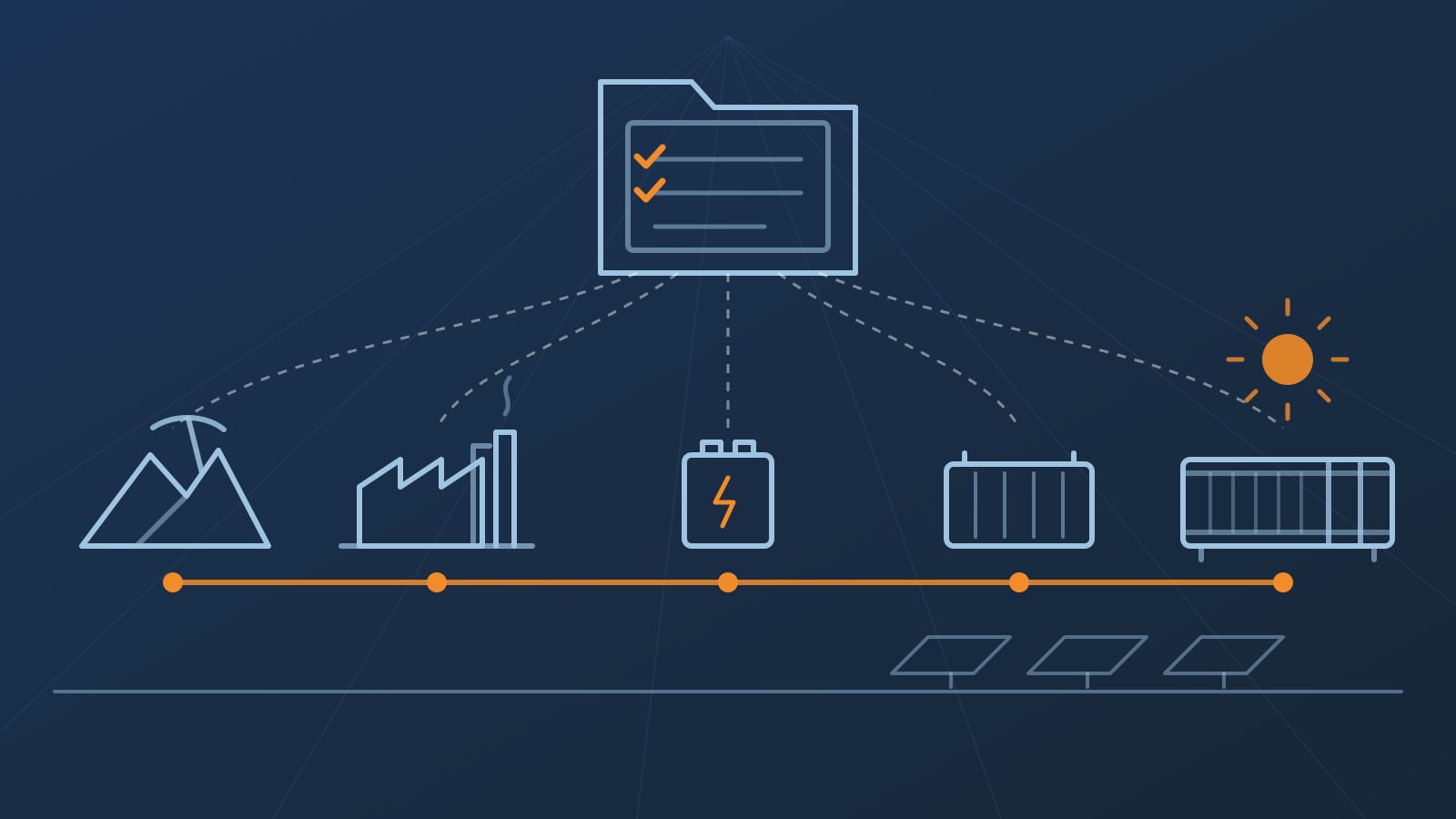
The board report also says the project is procured in a single stage under a FIDIC Yellow Book (design-build) EPC contract, and that the battery system comprises lithium-ion battery modules, a battery management system, power conversion systems, thermal management and auxiliary equipment. Trade press reported in October that bids close on 10 December 2026 and linked the tender notice on the EBRD's e-procurement portal, ECEPP. Check the dates in the tender itself: under the EBRD's standard data sheet, only participants who are registered on ECEPP and have expressed interest can access the documents and receive clarifications, addenda and amendments.
The project documents also say how the supply chain will be handled: the supply chain of the solar panels and the battery system “will be managed through specific representations and requirements in public procurement bidding documents”, and the environmental and social action plan includes supply-chain mapping, a declaration and verification of sourcing from assessed suppliers. Much of that information can only come from the battery manufacturer.
Who bids, and where the manufacturer fits
The EBRD places no restriction on the procurement of goods, works or services from firms of any country, whether or not the country is a member of the bank (Procurement Policies and Rules, article 2.7). The EPC contractor, alone or in a joint venture, is the participant and may take part in only one proposal for a contract — otherwise all the proposals it is involved in are rejected. A subcontractor, a term that also covers suppliers such as the battery manufacturer, is not deemed a participant and may be named in several competing proposals.
Under both the 2022 and the 2026 rules, a participant is excluded if it has been declared ineligible under the EBRD's Enforcement Policy and Procedures, or if it, the goods or any supplier of them is subject to United Nations Security Council sanctions under Chapter VII; further grounds, such as a conflict of interest or anti-competitive conduct, apply subject to the bank's no-objection. The 2026 rules add a new ground of this kind — credible allegations of forced labour, child labour or human rights violations against the firm, a member of its joint venture or their affiliates, meaning allegations corroborated in court judgments or in reports of intergovernmental or recognised human rights organisations — and require a subcontractor to which any of the grounds applies to be replaced.
The 2026 rules apply to operations that had not received concept approval before 1 September 2026, or where the client and the bank agree; the Beni Mhira project was approved by the EBRD's board on 22 July 2026, which points to the 2022 rules unless the client and the bank agreed otherwise. Each tender's data sheet states which version applies.
What you need from the manufacturer
Manufacturer's Authorisation. Where the procurement document requires it, the bidder submits an authorisation from the manufacturer of the goods, plant or equipment, on the manufacturer's letterhead: the manufacturer states that it is the official manufacturer, with factories at named addresses, authorises that bidder to submit the proposal and then negotiate and sign the contract, and extends its full guarantee and warranty for the equipment offered. Each manufacturer — for example of the batteries and of the power conversion system — signs its own form; none is needed when the bidder is the manufacturer.
Manufacturer's capacity. The EBRD's library of forms also includes form MAN-1, which the bidder fills in and signs where the tender asks for it: for each production site, its name, installed capacity, the year the line was installed, the capacity available during the contract period, the owner, and whether the site is owned, rented, leased or contracted. The data comes from the manufacturer, so ask early which line will make your cells and modules and how much of its capacity is free in your delivery window.
Subcontractor forms. If the tender sets qualification requirements for subcontractors, the EBRD's template asks the bidder to show that each subcontractor has successful experience of works, services or supplies of comparable nature, complexity and magnitude, and a sound financial position, on forms SUB-1 to SUB-4: the list of proposed subcontractors, their eligibility, experience and financial situation.
→ How to verify a Chinese factory before you order: licence, export and certificates
Supply chain and forced labour: what the client must do, and what bidders should expect
Under the EBRD's 2024 Environmental and Social Policy, the client — the borrower, here STEG — must identify significant labour risks in the project's core supply chains, namely child labour, forced labour and occupational health and safety, and monitor them. Where significant risks are found, it must cause the supplier to take appropriate measures; where it has a direct contract with the supplier, it uses reasonable efforts to write the labour requirements into that contract, and with sub-suppliers it uses the leverage it has. Where forced labour is found, it keeps buying from that supplier only after receiving satisfactory undertakings or evidence that the supplier is committed to preventing such impacts and providing remediation, and notifies the EBRD; as a last resort, it disengages responsibly (ESR 2, paragraphs 44–47). Bidders should therefore expect supply-chain requirements in the tender documents, as the Beni Mhira documents announce, and questions they can only answer with the manufacturer's help.
The EBRD's sector guidance on battery supply chains (June 2024) is written for project sponsors and is not binding, but it shows how the bank looks at these risks. It describes the chain as raw material extraction, raw material processing, cell component production, cell and pack production and final assembly; notes that more than 75% of battery cells are made in China and that China processes more than half of the world's lithium, cobalt and graphite; and warns that traceability is generally limited and only possible after the cell is assembled. Its examples of actions range from foundational ones, such as identifying the battery type and its key raw materials and supplier self-assessment questionnaires, through intermediate ones, such as checking the country of origin of the most relevant raw materials, to leading practice, such as sourcing from certified mines or participating in a traceability initiative like the Global Battery Alliance's Battery Passport, a reporting framework the alliance is still developing.
For lithium iron phosphate (LFP) storage, the key materials are lithium, the iron phosphate cathode and the graphite anode. Our checklist for the manufacturer: the addresses of the cell factory and of module and container assembly; its cathode and anode suppliers; the processors of lithium and graphite and their countries; a signed declaration on forced and child labour that it also requires from its own suppliers; and any audits or certifications. Agree in writing how far the map goes: the guidance itself notes that traceability to the mine site is usually hard to accomplish and that, for most raw materials, risks are very similar at country level.
→ Battery storage for business: how to size it, what to check and what it costs
Terms to settle with the manufacturer before you price
The board report for Beni Mhira names the mitigant for technology risk: procurement from an experienced original equipment manufacturer, supported by performance and availability warranties and a battery augmentation strategy embedded in the operation and maintenance framework. Our checklist for the manufacturer before you price: the guaranteed energy for each year and where it is measured, the availability guarantee, the round-trip efficiency and auxiliary consumption, and the augmentation plan with its cost — which modules or containers are added, and when.
Test reports for the exact system offered: IEC 62619 for cells and batteries, the UL 9540A report with its edition and the levels tested, the UN 38.3 test summaries for transport, and evidence that the power conversion system meets the grid code; and the factory acceptance test protocol, with your right to witness the test. The technical requirements of your tender prevail over this list.
China cancels the export VAT rebate on batteries from 1 January 2027; from April to December 2026 the rate is 6%. This applies to the battery products listed in the annex to Announcement No. 2 of 2026 of the Ministry of Finance and the State Taxation Administration, which include lithium-ion accumulators (HS 8507.60) — check the code under which your equipment will be declared. The export date on the Chinese customs declaration decides which rate applies. If your batteries are likely to leave China in 2027, ask for a price with an export date from 1 January 2027. Agree also how long the manufacturer's price stays valid: proposals must remain valid for the period set in the tender, and the client may ask bidders to extend it.
→ China ends the export VAT rebate on batteries from 1 January 2027: what it means for buyers of battery storage and UPS · AlmaSADI contracts: what to demand from a Chinese battery supplier · Pre-shipment inspection in China: what to check before you pay the balance
How we help
We work with storage manufacturers in China. For an EPC bidder we ask the manufacturer for the authorisation for your bid on its letterhead, the data for the capacity form if the tender asks for one, supply-chain information as far as it can be documented, with signed declarations, test reports — which we check against the standards in your tender — warranty and augmentation terms in writing, and a price with a 2027 export date. A supplier may be named in several proposals, so we can work with more than one bidder in the same tender where the tender's conflict-of-interest rules allow it; we never pass one bidder's prices or documents to another.
Send us the tender, its closing date and the configuration you are bidding: power, energy, duration and grid voltage. The facts here are from the EBRD's Procurement Policies and Rules (2022 and 2026), its standard procurement documents and forms, its 2024 Environmental and Social Policy and its battery supply-chain guidance, the Beni Mhira project page, press release and board report, Announcement No. 2 of 2026 of China's Ministry of Finance and State Taxation Administration, and trade press reports on the tender dates, read in November 2026; the documents of the tender itself prevail.
→ Energy storage PCS 500 / 630 kW · Liquid-cooled commercial storage cabinet 209 / 261 kWh