
An AlmaSADI award is a promise to CAMMESA: storage that delivers at least four consecutive hours on the national grid for up to 15 years, commercial operation no later than 31 December 2029, and quarterly payments to CAMMESA until the plant is running. Much of that risk sits with the battery supplier. Here is what to get from a Chinese manufacturer in writing before you sign — based on the tender documents (Energy Secretariat Resolution 50/2026), checked in November 2026.
What the award commits you to
The AlmaSADI tender (Energy Secretariat Resolution 50/2026) contracted battery storage on the national grid that delivers at least four consecutive hours, with a 700 MW target; the awards were made by Resolution 155/2026. Commercial operation requires CAMMESA's Technical Procedures No. 1 and No. 4 and enabled metering, communication and real-time operation equipment, no later than 31 December 2029.
The agreement runs for up to 15 years from commercial operation or from 1 January 2027, whichever comes first. Until commercial operation the winner pays CAMMESA — in pesos, at the Central Bank's Communication “A” 3500 rate — US$4,000 per MW of contracted power on award and then every quarter through 2027, US$6,000 per quarter in 2028 and US$8,000 in 2029; at commercial operation these payments are refunded in full if it comes by 30 June 2027, 75% by 30 June 2028 and 50% by 31 December 2029.
For a 20 MW project that is US$80,000 on award and every quarter of 2027, US$120,000 a quarter in 2028 and US$160,000 a quarter in 2029. A late plant costs you in three ways: the quarterly payments continue, the refund shrinks, and because the term counts from 1 January 2027 at the latest, every month of delay past that date is a month less of the term. The tariff also rewards an early start: the annual factor on the monthly capacity payment is 1.25 in 2027 and 1.10 in 2028, against 1.00 in 2029–2036. Reaching 31 December 2029 without commercial operation, or missing one of these payments, is grounds for terminating the agreement with no claim against CAMMESA or the State — and the payments are refunded only at commercial operation.
→ How to import equipment from China to Argentina: taxes, paying the factory and certificates
Capacity over the term: the guarantee that protects your revenue
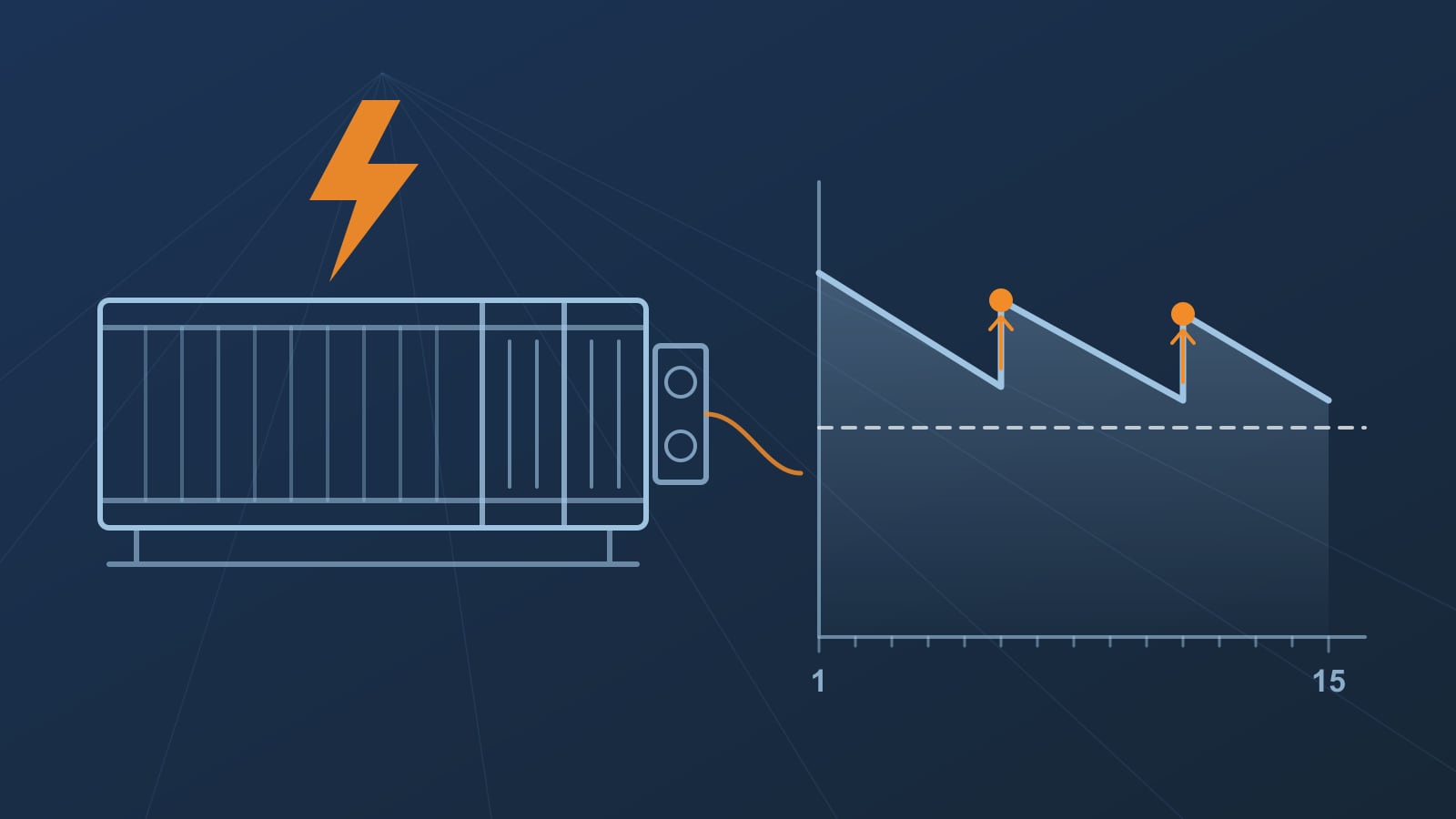
CAMMESA pays each month for the storage power available, multiplied by HAV/HAC: the hours of continuous delivery it verifies in operation, up to five, divided by the four hours committed. Lithium iron phosphate (LFP) batteries lose capacity with cycles and with age, so when the plant can no longer hold its power for four hours, the payment falls with it. Energy installed above four hours works the other way: if CAMMESA verifies the longer delivery in operation, it can raise the payment while the batteries are new, and as they age it becomes the reserve that keeps four hours.
The usual ways to keep the hours are extra energy at the start (overbuild) or battery modules added later (augmentation). How much you need depends on the capacity curve the manufacturer will guarantee — so that curve, not the datasheet, is the number to negotiate. Two more inputs from the tender: CAMMESA may require up to 180 full cycles a year, and the annual factor falls to 0.50 in 2037–2041.
Ask the manufacturer to put into the contract the guaranteed energy for every year of the term and where it is measured: at the battery's DC terminals, or as AC energy after the losses of the power conversion system (PCS) and the transformer (the tender defines the contracted power as net power at the point of connection to the grid). Ask also for the round-trip efficiency and the auxiliary consumption for cooling and control: each month CAMMESA charges the difference between all the energy the plant draws and the energy it delivers, at US$20/MWh (the spot price from 2037).
The contract should also state the operating conditions the guarantee assumes — full cycles per year, depth of discharge, average cell temperature and the state of charge at rest — so you can check them against your dispatch; the remedy when capacity falls below the curve: added modules at the manufacturer's cost, delivered and installed, or compensation; and the price of a guarantee for the whole term compared with the manufacturer's standard one.
→ Battery storage for business: how to size it, what to check and what it costs · Commercial storage cabinet 20–50 kW / 80–120 kWh
The commercial-operation date is set in the factory
Work backwards from the refund dates. Before the plant runs, the batteries need a production slot, a factory acceptance test, booking as dangerous goods, the voyage to Argentina and customs clearance; then come installation, commissioning and CAMMESA's procedures. A container with the batteries installed normally ships as UN 3536, while modules shipped separately are declared as UN 3480 or UN 3481 — confirm with the carrier. Get in writing: the production slot and the delivery date, with a penalty for delay that matters compared with what a late quarter costs you; the factory acceptance test protocol, with your right to attend or send an inspector; and the transport documents the carrier will ask for, starting with the UN 38.3 test summaries for the cells and batteries.
Argentina's 0% duty line for battery storage in a container applies only to interconnected batteries forming up to 18 modules of no more than 2,500 V each, with fire-suppression, cooling and control equipment, all housed in a metal container; batteries that do not meet every condition pay 18%. Ask the factory for a datasheet that shows each condition, so that your customs broker can support the code. The line is on Argentina's national list of exceptions to the Mercosur common tariff, which Mercosur authorized until 31 December 2028 (Decision 11/21) — ask your broker what would apply to a shipment that lands later.
Agree the payment schedule with your bank before you sign: whether you may pay a deposit before production depends on the Central Bank's rules for your tariff line — see the payment section of our Argentina guide.
→ How to import equipment from China to Argentina: taxes, paying the factory and certificates · Pre-shipment inspection in China: what to check before you pay the balance
Price: no Chinese export rebate on batteries from 2027
China cancels the export VAT rebate on batteries from 1 January 2027; from April to December 2026 the rate is 6% (Announcement No. 2 of 2026 of the Ministry of Finance and the State Taxation Administration). The rate is decided by the export date on the Chinese customs declaration. Batteries that are ordered now and still have to be built will most likely be exported in 2027, so ask for the price with an export date from 1 January 2027 — then the end of the rebate will not move the price after you have taken the offer to your bank.
Ask also under which tariff code the factory will declare each item — batteries, PCS, transformer. The change covers batteries; inverters and other static converters (HS 8504.40) are not on the list.
Documents to get before you sign
Test reports for the system you are buying, not for another model: IEC 62619 for the cells and batteries; a UL 9540A test report — a North American fire-propagation test method that produces data rather than a pass mark — with its edition and the levels tested; IEC 62477-1, or the safety standard your engineers specify, for the PCS; the UN 38.3 test summaries; and evidence that the PCS meets the grid requirements your connection studies use.
A manufacturer's authorization letter if you buy through a trading company, so that the warranty is backed by the factory; two or three delivered container projects of similar size, with country, megawatt-hours and year; the warranty terms as an annex to the contract, not a brochure; and the factory's commitment to provide the technical data and on-site support your engineers need for CAMMESA's procedures.
→ How to verify a Chinese factory before you order: licence, export and certificates
How we help
We ask storage manufacturers in China to put these terms in writing — the capacity curve over the term, the authorization letter, references, the production slot and the 2027 price — and compare offers on the same basis. We can combine containers, PCS and transformers from different factories in one order, arrange inspection before shipment and prepare the documents your customs broker and bank ask for. Send us the contracted megawatts, the site and your target date for commercial operation.
The tender terms were checked in Energy Secretariat Resolution 50/2026 and its annex — the tender rules and the storage agreement — and in Resolution 155/2026, the duty line in Decree 557/2023 as amended by Decree 781/2025, and the rebate in Announcement No. 2 of 2026, in November 2026. CAMMESA's clarification circulars, made part of the tender rules by Resolution 136/2026, can refine details, and rules can change: check the figures against your signed agreement and confirm them with your advisers.