
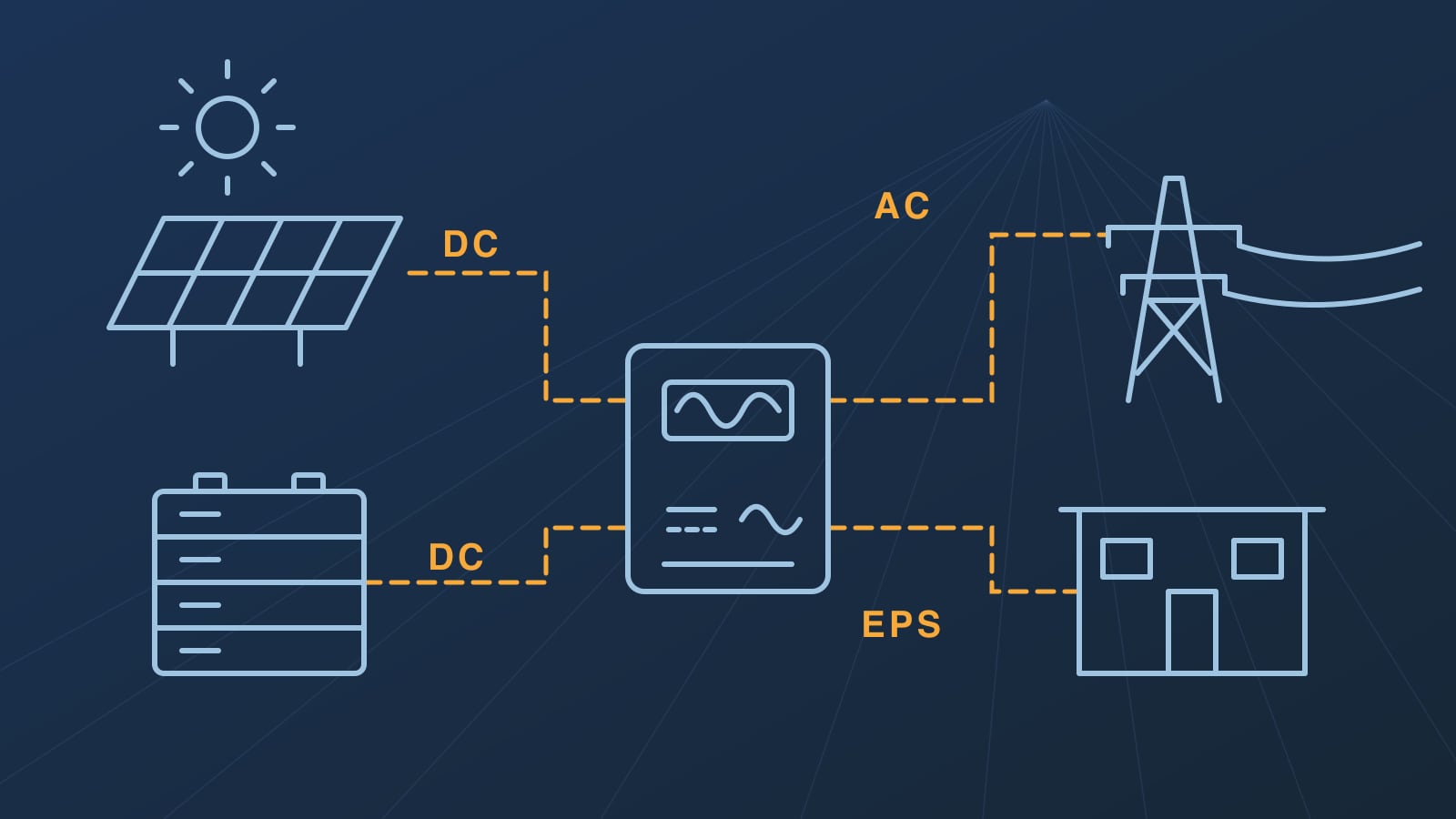
A hybrid inverter is the one box that connects solar panels, a battery and the grid: it turns solar DC into AC, charges and discharges the battery, feeds the building and keeps a backup circuit alive when the grid fails. A shop, a clinic, an office, a farm or a small workshop usually needs from a few to a few tens of kilowatts — but the model must match your supply, your loads, your panels and your country's connection rules. Here is what to check before you order, with the rules and standards checked in November 2026.
Single-phase or three-phase: match the supply first
Start from the meter, not from the catalogue. The inverter's output must match the voltage, the number of phases and the frequency of your connection; a wrong version cannot be fixed on site.
Most hybrid inverters made in China come in two versions: single-phase 230 V and three-phase 230/400 V, usually rated for 50 and 60 Hz. They fit Chile, where single-phase supply is 220 V and three-phase 380 V at 50 Hz, and the Emirates, with 230/400 V at 50 Hz. In Peru three-phase supply is either 380/220 V or 220 V between phases — a 230/400 V model fits only the first. Saudi Arabia runs at 60 Hz, and its low-voltage networks are 400/230 V, 380/220 V or 220/127 V — a 230/400 V model does not fit a 220/127 V supply. Nor do these versions fit the North American pattern used in Mexico and Colombia, at 60 Hz: single-phase supply at 120–127 V, 120/240 V split-phase in homes and small shops (in Mexico often two phases of a 220Y/127 V system instead), and three-phase 208Y/120 V or 220Y/127 V in commercial buildings. For those sites you need a version built for them — a 120/240 V split-phase model, a model that supports a two-phase connection to a 220Y/127 V or 208Y/120 V system, or a three-phase model with a 208–220 V output — and the factory should confirm the exact output voltage, frequency and neutral arrangement in writing before production. Check also that a grid-code profile for your country exists in the firmware: it sets the voltage and frequency limits the inverter works within.
On a three-phase site, ask what share of the rated power one phase can carry on its own — real loads are rarely balanced.
Size the power: continuous and surge
Two numbers decide the size. The first is continuous power in kW at the temperature of your site. Data sheets give the rated power and the ambient temperature above which output is reduced; under a hot roof or in an unventilated room that temperature is reached on summer afternoons, so read the derating curve, not only the headline figure. Altitude also reduces cooling: if the site is high — Bogotá is at about 2,600 m and Mexico City at about 2,240 m — ask for the rating at your altitude.
The second is overload or surge capacity: how much above the rated power the inverter can deliver, and for how long. Motors, compressors and pumps draw several times their running current for a moment when they start — longer when they start under load — and in backup mode the inverter must supply that alone. Compare the surge figure on the data sheet with the starting demand of your largest motor; if the margin is thin, choose the next size up or add a soft starter.
Size the backup output to the loads that must stay on, not to the whole site: the tills, the network equipment, the refrigerators, the clinic's equipment, lighting. The rest stays on the grid.
Solar input: MPPT trackers and DC voltage
Panels connect through one or more maximum power point trackers (MPPT). Strings on one tracker must be identical — the same number of the same modules. Strings of different length, for example on a roof and on a carport, go on separate trackers; for strings facing different directions, ask your installer whether one tracker is enough. Check three figures per tracker: the maximum input current (how many strings you can parallel), the MPPT voltage range and the absolute maximum DC voltage — 1,000 V on the three-phase models we offer, usually lower on single-phase units.
The maximum DC voltage is a safety limit, not a target. A string's open-circuit voltage rises in the cold, so size it with the module's open-circuit voltage corrected to the coldest morning at the site, using the temperature coefficient from the module data sheet. Ask also for the maximum PV power the inverter accepts: most allow more panel power than the AC rating, but the limit is in the data sheet.
Battery: 48 V or a high-voltage stack
Hybrid inverters are built for one of two battery types. Low-voltage inverters work with 48 V batteries (nominal 51.2 V for lithium iron phosphate), which are simple to add in parallel and suit smaller systems — the low-voltage models we offer go up to 12 kW. Above that the current becomes the problem: 10 kW from a 51.2 V battery is about 195 A, which means thick cables, big fuses and losses. High-voltage inverters use a stack of modules in series, from about 100 V to several hundred volts (the stack we offer is 102–410 V nominal with two to eight modules, and the three-phase models we offer accept 150–800 V — two modules are below that range, so check the minimum number of modules on the inverter's compatibility list); at 200–400 V the same 10 kW flows at 25–50 A. For larger three-phase systems a high-voltage stack keeps the currents manageable.
In either case the battery management system reports voltage, current, temperature and state of charge to the inverter over CAN or RS485, and the protocol must be the one the inverter expects. Ask the factory to confirm in writing that your exact battery model is on the inverter's compatibility list and that the pair can charge and discharge at the power you need — the battery's own current limit (its C-rate) can be the bottleneck. Choose lithium iron phosphate and ask for the IEC 62619 test report and the UN 38.3 test summary for shipping; sizing in kWh, safety and shipping are in our guide to battery storage for business.
Backup: what the EPS port does and how fast it switches
When the grid fails, every grid-connected inverter must stop feeding the grid; the test for this anti-islanding protection is IEC 62116. That is why a hybrid has a separate backup output, often labelled EPS (emergency power supply), back-up or off-grid. Only the loads wired to that port get power in an outage; the rest of the building goes dark. So an electrician moves the critical circuits to a separate panel fed from the EPS port, and the rest stays on the grid side.
The switch is not instant in every model. Some hybrids switch in under 10 milliseconds — the models we offer do — which most lighting, motors and computers ride through. Others take longer, and some first disconnect from the grid and then restart the backup output, which takes seconds. The data sheet gives the figure; ask whether it applies at full load. An online UPS is different: its inverter runs all the time, so there is no switchover at all (class VFI in IEC 62040-3). For servers, network equipment and medical devices that must not reboot, put a small online UPS behind the hybrid's backup port — see our UPS guide.
Generator support
Where outages are long, a diesel generator and a hybrid work well together: the generator runs fewer hours at a better load, and the battery covers short cuts without starting it. Ask three questions. Is there a separate generator input? Can the inverter start and stop the generator automatically through a dry contact when the battery is low? And can it limit the power it draws from the generator, so that charging plus the loads do not overload it? Generator frequency drifts under load, so check the acceptance window of the generator input too.
Grid connection and export rules by country
Whether you may export surplus solar power, and what you get for it, is set by national rules, and the connection goes through the distribution company. Examples from the countries covered by our guides:
Chile. Net billing — article 149 bis of the General Electricity Services Law, introduced by Law 20.571 and amended by Law 21.118 of 2018 and, for storage, by Law 21.505 of 2022 — lets customers on regulated tariffs with generating equipment of up to 300 kW inject surplus energy into the grid, including energy stored in batteries, and have it credited on the bill. An SEC-authorised installer declares the installation to the regulator, the SEC (form TE4 through the e-Declarador system), together with the equipment used. The inverter the panels connect to must be authorised by SEC and, for installations declared since 1 January 2026, have arc-fault protection (AFCI) — built in (SEC accepts AFCI to IEC 63027 and/or UL 1699B) or an external solution accredited and authorised by SEC as a special project. Ask the factory for both before you order.
Mexico. Under the Electricity Sector Law of 18 March 2025, distributed generation means plants of less than 0.7 MW on a distribution circuit; they need no generation permit. The detailed rules are still those of Resolution RES/142/2017 of the former regulator, which stay in force where they do not contradict the new law: an interconnection contract with the distributor (CFE) and three ways to be paid for surplus — net metering, net billing or total sale. Its technical annex treats an inverter certified to the factory and field tests of IEEE 1547 and UL 1741 as certified (UL 1741 is used until a Mexican technical specification or official standard is issued); if the inverter has no such certificate, the distributor may ask for test evidence from an inspection unit or a certification laboratory. The installation must meet the wiring standard NOM-001-SEDE-2012. The regulator CRE was replaced by the National Energy Commission (CNE), and the 2017 resolution was written for plants under 0.5 MW, so confirm the current contract model with CFE before you buy.
Colombia. CREG Resolution 174 of 2021, which repealed Resolution 030 of 2018 and has been amended several times since, governs small-scale self-generation (AGPE) up to 1 MW. Surplus from renewable sources is first credited against the energy you import in the same billing period — credited energy still carries a commercialisation charge, and above 100 kW also network and other charges; what exceeds your imports is paid at a wholesale-market price set under CREG rules, not at your retail tariff. A system of up to 100 kW with surplus export is exempt from the simplified connection study, and the distributor checks the inverter against the standards named in the connection form through a product certificate from an accredited body. The inverter also falls under RETIE, which must be met before customs release — see our Colombia import guide.
Peru. The regulation on distributed generation for electricity users has been a draft since November 2024 (Ministerial Resolution 439-2024-MINEM/DM) and, as of November 2026, we have not found it adopted. Until it is, plan for self-consumption without export and agree the connection with your installer and the distribution company.
Saudi Arabia and the Emirates. In Saudi Arabia solar inverters fall under SASO's technical regulation for solar photovoltaic systems, handled through SABER; the connection of small solar systems is governed by the electricity regulator, SERA, and carried out by the Saudi Electricity Company — ask them for the current rules. In the Emirates the federal solar regulation (Cabinet Resolution No. 10 of 2020) covers PV modules, inverters and interface protection and requires a conformity certificate before connection to the grid; the connection goes through the local utility, such as DEWA in Dubai.
Certificates regulators ask for
Ask the factory for the test reports themselves — with the laboratory name and the exact model tested — not just a list of standards. The core set is IEC 62109-1 (safety of power converters for PV systems, general requirements) and IEC 62109-2 (particular requirements for inverters, including multiple-mode inverters used with batteries); IEC 62116 (anti-islanding test); IEC 61727 (characteristics of the utility interface); and the electromagnetic compatibility reports of the IEC 61000 series. Where AFCI is required, add the arc-fault test report to IEC 63027 or UL 1699B. Country rules add their layer: SEC authorisation in Chile; certification to UL 1741 and IEEE 1547 in Mexico (otherwise the distributor may ask for test evidence), plus the NOM certificates checked at customs — see our Mexico import guide; the RETIE conformity document and product certificate in Colombia; the SABER certificate in Saudi Arabia; the conformity certificate under the federal solar regulation in the Emirates. The grid-code approval for your country is a separate document — ask for it by name.
Arc-fault protection (AFCI) on the DC side detects arcing at a loose connector or a damaged cable and switches the circuit off, reducing the risk of fire. We found it mandatory in three of the countries covered by our guides. In Chile, every grid-connected PV installation declared since 1 January 2026 needs it, as described above. In Mexico, the wiring standard NOM-001-SEDE-2012 (article 690-11) requires it for PV systems on or entering a building with a maximum system voltage of 80 V or more. In Colombia, RETIE requires it for grid-connected PV systems operating at 80 V DC or more, and allows it to be built into the inverter. Elsewhere, ask your installer what the local code requires. On the three-phase models we offer AFCI is available on request — ask for the IEC 63027 or UL 1699B test report; for a single-phase model, confirm it with the factory before you order.
Monitoring and warranty: what to ask
Monitoring: most hybrids come with a Wi-Fi or 4G data logger and a cloud portal, or offer one as an option. The logger is a radio device, so check your country's radio rules before shipping — depending on the country and on whether it uses Wi‑Fi or 4G, that can mean an approval, a registration or a declaration of conformity; see our import guides. Ask where the servers are, whether you can read the data locally over Modbus or RS485 without the cloud, and whether the portal sends alarms by e-mail. If you run an energy management system, ask for the Modbus register map.
Warranty: ask for the term in years, separately for the inverter and the battery, what it covers, who carries out the service in your country, how fast a replacement ships, and whether the warranty can be extended. Ask who updates the firmware and what happens to the warranty if a third party does. A warranty that can only be honoured by returning the unit to China is worth less than one with a spare unit in your country.
A worked example
A clinic on a three-phase 380 V supply. The bills show a peak demand of 18 kW; the loads that must stay on in an outage add up to 9 kW, including a 2.2 kW compressor; from 18:00 to 22:00 the clinic draws about 7 kW on average.
Power: a 20 kW three-phase hybrid covers the 9 kW of backup loads and, on a clear day, much of the midday demand from solar. If the data sheet gives 1.5 × rated power for 10 seconds, that is 30 kW in total — about 10 kW per phase. A 2.2 kW motor started directly draws several times its running current for a moment: its locked-rotor current (LRA, on the nameplate or data sheet) times the voltage gives the starting demand in kVA. Add the other backup loads running at that moment, about 7 kW, and compare: for a three-phase compressor with the 30 kW; for a single-phase one, whose start falls on one phase, with about 10 kW, counting only that phase's share of the other loads. In an outage the real power for the start comes from the battery, so check its discharge limit too — the stack we offer is rated at 50 A, about 18 kW at 360 V. If the margin is thin, fit a soft starter.
Battery: 7 kW × 4 h = 28 kWh. With 90% depth of discharge and about 95% efficiency on the way out, the nameplate must be 28 ÷ 0.9 ÷ 0.95 ≈ 33 kWh — for example seven high-voltage modules of 5.2 kWh, 36 kWh. Discharging 7 kW from 36 kWh is about 0.2 C, well within what lithium iron phosphate modules allow. At a stack voltage of about 360 V (seven 51.2 V modules) the current is about 20 A; from a 51.2 V battery it would be about 137 A.
Panels: 40 modules of 580 W make 23.2 kW, 1.16 times the inverter's AC rating — check the maximum PV power in the data sheet. If the module's open-circuit voltage is 52 V at 25 °C, its coefficient −0.25% per °C and the coldest morning at the site 0 °C, the voltage rises to 52 × (1 + 0.0025 × 25) ≈ 55.3 V: 16 modules in series give 884 V, under a 1,000 V limit; 18 would give 995 V — too close. So, with three trackers, two strings of 16 and one of 8, each on its own tracker; with two trackers, as on the three-phase models we offer, two parallel strings of 13 on one and a string of 14 on the other, if the trackers' current limits allow. Strings of different length always go on separate trackers, each within the tracker's current limit and MPPT voltage range.
How Bridgetop helps
We select the inverter model for your supply, loads and panels, check that the battery is on its compatibility list, and compare the factory's test reports and certificates with the goods — model by model, before production. We then arrange the export from China with full documents. Your customs broker clears the goods at destination, and your installer declares the installation to the regulator and the distribution company; we give both the documents they need.
Rules and standards were checked in November 2026 against the IEC webstore and official documents: Mexico's 2025 electricity law, RES/142/2017 and NOM-001-SEDE-2012; Colombia's CREG Resolution 174 of 2021 and RETIE; Chile's electricity law and SEC instructions; Osinergmin's connection tables in Peru; SASO and Saudi Electricity Company standards; and the Emirates' solar regulation. They can change — we confirm them in the quote. Related guides: battery storage for business, UPS for a server room, and importing from China to Chile, Mexico, Colombia and Saudi Arabia.